Task preparation UI
Normal keyboard shortcut, goal entry and sensitivity selection
Task preparation observed in the local browser
Command Fabric
Exploratory product development · Prototype
Command Fabric is an exploratory prototype for planning and bounding agent work: it turns a goal into a proposed route, roles, review steps and evidence requirements before execution.
Command Fabric is an exploration of the work around an agent: defining the request, deciding which tools and roles fit, setting review points, and keeping evidence of what happened. Its task form turns a goal and sensitivity choice into a proposed route and work packet.
I use the prototype to explore what software may decide on its own, what a reviewer needs to see and when work should stop. I design the workflow and review points, then build and examine them with AI coding tools.
Inspect the task-preparation screen. This recorded view shows planning before execution.
Recorded development screens · demonstration data
A proposed work route makes roles, review steps and evidence requirements visible before execution.
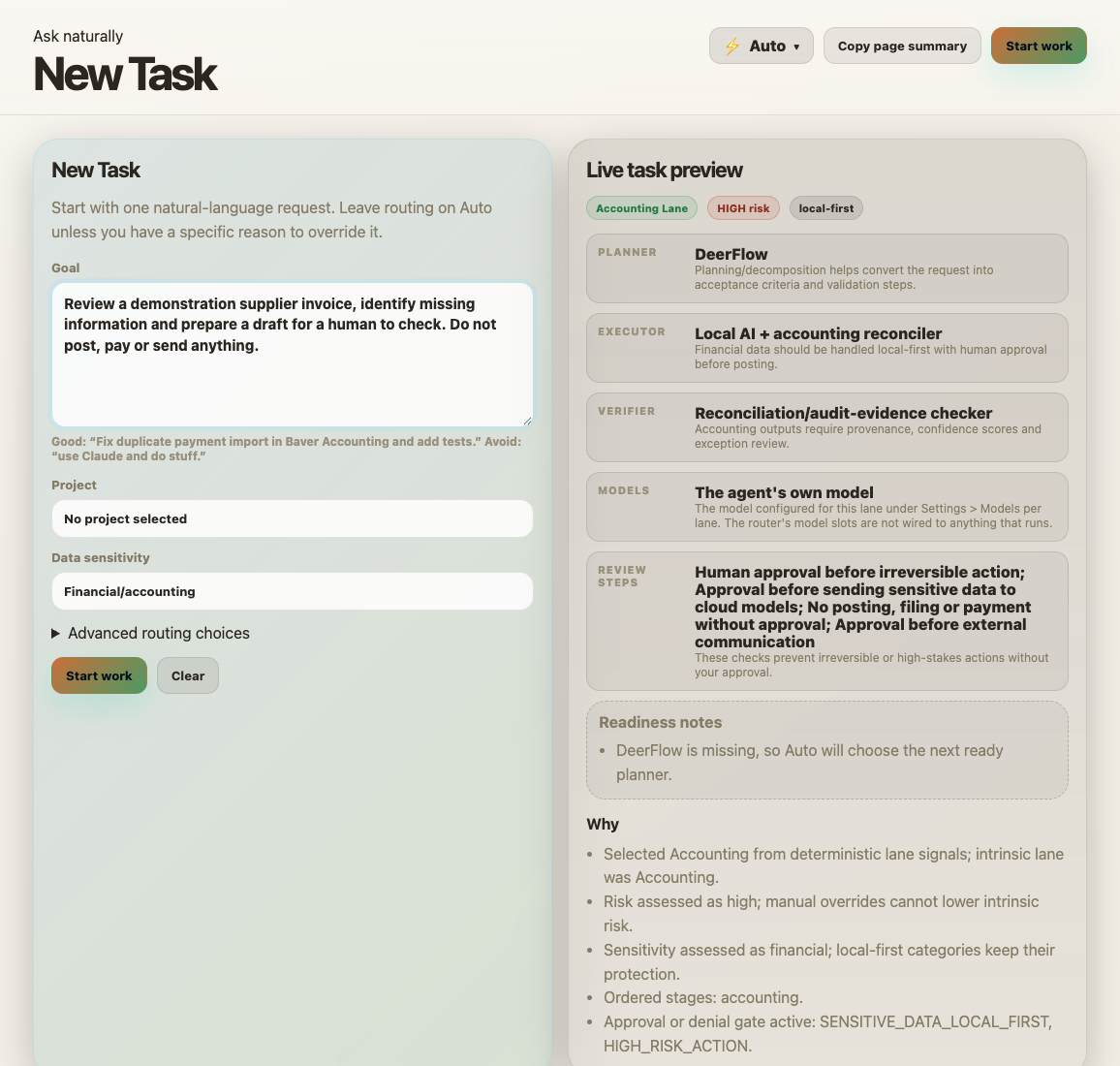
Screenshots show the development build using demonstration data.
The prototype also includes paths for execution, review, approval, correction and evaluation. The route shown in the preview follows fixed rules; model and agent connections are separate.
In the example, a sample invoice-review request produces an accounting route, proposed roles and approval conditions before work starts. The user can inspect why the route was chosen and where it must stop for a decision.
I have also explored local inference and evaluation. Saved decoding-depth experiment records provide a separate example of examining local execution; they are distinct from the task-preparation screen and from model fine-tuning.
A person describes the goal and relevant boundaries
Deterministic classification and routing
Executor, reviewer, stop conditions and evidence
Approval, execution, review and repair handling
Normal keyboard shortcut, goal entry and sensitivity selection
Task preparation observed in the local browser
Approval, output boundaries, reviewer decisions and repair paths
Implemented in the prototype
Separate earlier decoding-depth and evaluation work
Earlier exploration; no new run or model training claimed
| Mode | Current status |
|---|---|
| Captured example | Task packet prepared in the local browser |
| Task routing | Deterministic rules; not an LLM decision |
| Controlled runtime paths | Implemented and checked with simulated connections |
| Local inference experiments | Prior experiments kept distinct from fine-tuning and current task capture |
Saved local-inference records were not rerun; no new training result or model-quality comparison is claimed.
Employment contact · Oslo, Norway
For a conversation about a relevant role, contact me by email or LinkedIn.